

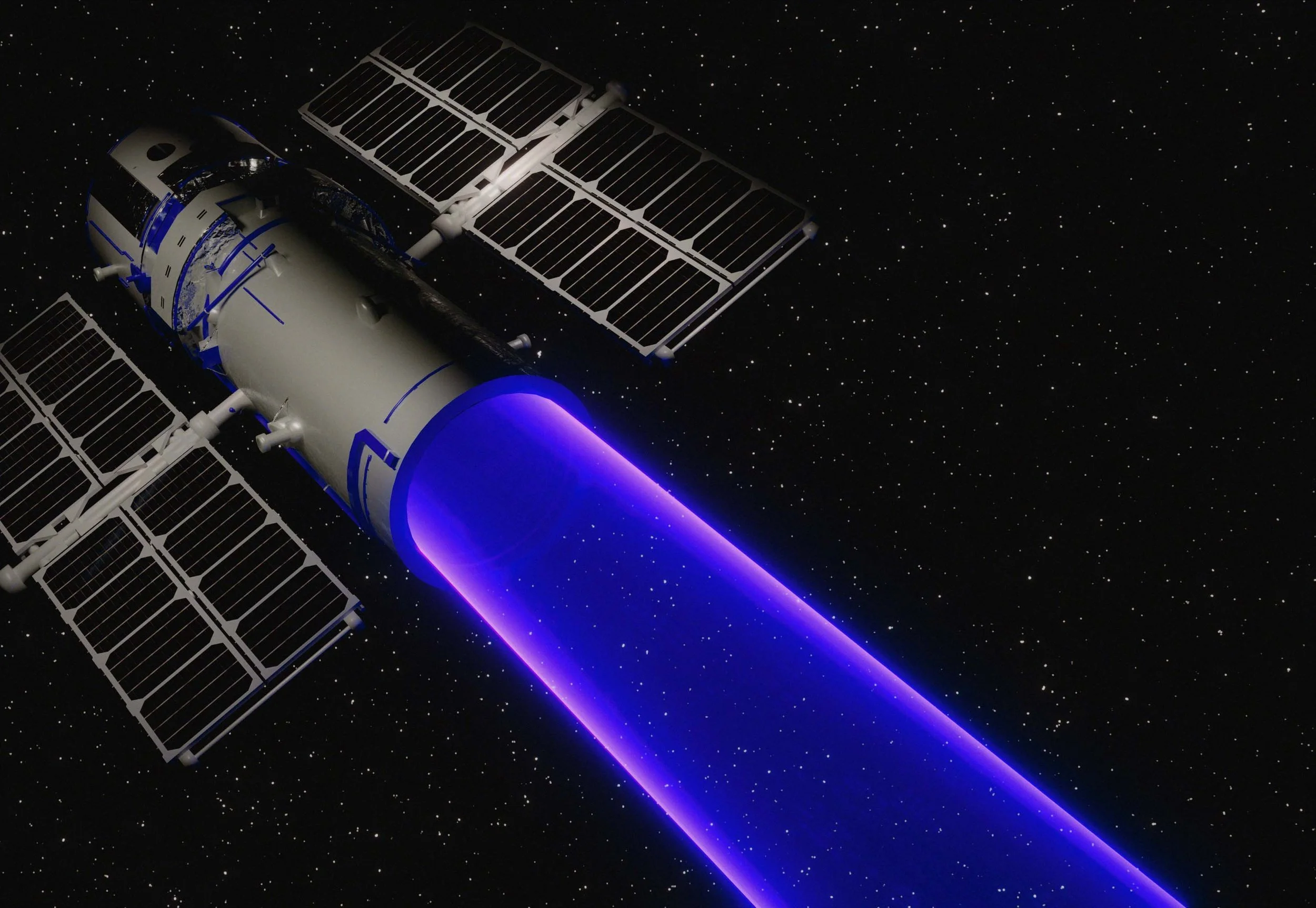
Volta Space Technologies U.S., in partnership with Cornell University’s Space Systems Design Studio and Magma Space, has been awarded a NASA Small Business Technology Transfer (STTR) Phase I contract to develop an architecture for an ultra‑stable attitude determination and control system that enables high‑accuracy laser power transfer from lunar orbit to the Moon’s surface.
This collaboration will develop technology to reduce vibrations associated with conventional reaction wheels and to improve the performance of space missions in which high-precision pointing is critical. The team formed by these three groups will address the challenge of precision pointing at extreme distances, a key requirement for effective orbital power beaming.
Lunar missions today face severe penalties from the heavy and expensive power sources required to survive the two-week lunar night. An orbital power model provides an alternative: scalable energy delivery with minimal landed mass, lower cost per watt‑hour, and access to features, such as permanently shadowed regions (PSR), that would otherwise be inaccessible. Precision pointing is key to the viability of this approach and microradian pointing precision is critical to maximum energy transfer.
The awarded effort, System with Ultra‑stable Magnetic Inertial Control Regulation for Orbital Beaming (SUbMICRO), will integrate Volta’s optical beaming payload with Cornell’s novel control software and Magma’s magnetically levitated reaction wheels to achieve sub‑microradian pointing knowledge and tenths‑of‑a‑microradian control on a commercial small‑satellite platform in low lunar orbit (LLO).
During Phase I, the team will focus on defining the architecture and technical specifications based on receiver size, link efficiency, and lunar mission needs. A system model to evaluate performance and produce a Phase II hardware‑in‑the‑loop test plan using Cornell’s spherical air‑bearing simulator will be built, laying the foundation for a scalable commercial ready system.
“Volta is proud to partner with Cornell and Magma on this important work”, said Volta U.S. President Paul E. Damphousse. “Together we will create the technological underpinnings of a pointing, acquisition, and tracking (PAT) system for not only orbital power transfer, but that can also be leveraged for other civil, commercial, and national security space missions with requirements for highly precise stability and pointing”.
“Extending life on the Moon beyond two weeks is essential for building a sustainable lunar economy, and power beaming will be key to making that possible”, said Magma’s CEO Alessandro Stabile. “We’re excited to contribute to this project and demonstrate how Magma’s technology can significantly enhance pointing accuracy and power transfer efficiency.”
“Lunar Missions that rely on beamed power demand a level of stability that traditional spacecraft have not yet been able to deliver,” said Mason Peck, Professor of Astronautical Engineering at Cornell University and former NASA Chief Technologist. “Our team expects to show that pushing pointing capability for such applications into the sub-microradian regime is not only possible on small satellites, but also essential for the future of sustainable lunar infrastructure. With SUbMICRO, we hope to make power beaming practical on commercial platforms and ultimately accelerate what humanity can do in cislunar space.”
ABOUT VOLTA
Volta Space Technologies (Volta) is building the energy grid for lunar operations, enabling endless and affordable operations for lunar surface missions. Volta’s Optical Wireless Power Transmission (OWPT) stack has been funded in part by the CSA, NASA, ESA, US Department of Defense (DoD), US Air Force Research Laboratory (AFRL) and US Naval Research Laboratory (NRL) through various awards and governmental programs. Volta will begin orbital power missions in 2028 and will subsequently extend the reach of future lunar-based power systems like nuclear fission. Volta’s long-term vision includes adding communication and positioning, navigation, and timing (PNT) services to become the dominant lunar utility provider.
ABOUT CORNELL SPACE SYSTEMS DESIGN STUDIO
The Space Systems Design Studio (SSDS) at Cornell University develops frontier technologies for agile, intelligent, and ultra-precise spacecraft, with a portfolio ranging from gram-scale ChipSats to advanced guidance, navigation, and control systems for deep-space missions. SSDS pioneered extreme-miniaturization and distributed-spacecraft concepts through the Sprite and KickSat flight experiments and has advanced high-performance autonomous control through research in magnetically actuated attitude control, low-disturbance platforms, and spherical air-bearing hardware-in-the-loop simulators. For SUbMICRO, SSDS brings its expertise in high-fidelity spacecraft modeling to enable sub-microradian stability on commercially viable platforms. The lab’s mission is to lower barriers to space exploration by creating scalable, high-impact technologies that empower both government and commercial partners to pursue ambitious goals in Earth orbit, cislunar space, and beyond.
ABOUT MAGMA
Magma Space is redefining how satellites operate with an autonomy and precision platform that gives spacecraft the ability to make smarter, faster, and more reliable decisions in orbit. By fusing AI-powered control with breakthrough maglev actuation technology, Magma is unlocking a new era of intelligent, self-sufficient space systems capable of supporting the most ambitious commercial and defense missions.